
Category: Stories

  • Will I Ever Smile Again? Junko’s Story of Ramsay Hunt Syndrome

    Will I Ever Smile Again? Junko’s Story of Ramsay Hunt Syndrome

    Will I Ever Smile Again? Junko’s Story of Ramsay Hunt Syndrome

    A story from the community

    Junko, who writes as Rita Code (Studio JMC), is a Japanese-born writer living in Las Vegas. Ramsay Hunt syndrome hit her on January 15, 2026, for the second time in her life, and she documented her recovery week by week in a ten-part series.

    Adapted from her English series at note.com/studio_jmc, with permission. Her words have been trimmed and rearranged, with small grammar and spelling fixes. Seth’s notes are marked separately so you always know who’s talking.

    A note from Seth

    Like everything on this site, this is one person’s experience, not medical advice. If your face just stopped moving, stop reading and get seen today.

    It started with my right ear

    One day, out of nowhere, the right side of my face stopped moving.

    Just like that.

    It was Ramsay Hunt Syndrome.

    From that moment on, every time I cautiously looked in the mirror, one question wouldn’t leave me: “Will this ever go back to normal?”

    Day 1: Thursday, January 15, 2026

    It started with my right ear.

    Maybe it’s a middle ear infection. Still, this prickling sensation feels off. Not quite like an ear infection.

    The prickling spread as the night wore on, creeping into my right shoulder, settling around my shoulder blade, and eventually building into a throbbing headache.

    I’d been running at full speed for weeks, organizing and hosting a big event, so I told myself I was simply running on empty. Sleep it off. You’ll be fine in the morning.

    That morning had started like any other. Up at 4 AM, Ashtanga yoga at 6, followed by a high-intensity Yoga Sculpt class. I was, by all measures, buzzing with energy.

    Day 2: Friday, January 16, 2026

    I smiled. A perfectly normal, symmetrical smile.

    I didn’t know that it would be more than three months before I would see that smile again.

    The discomfort was still there: the prickling in my ear, the tension in my shoulder and head. But I had trained myself to ignore pain. When you push your body every day, pain becomes background noise.

    Later that day, while having lunch with my husband, I felt it. A sharp, sudden tingling at the tip of my tongue.

    This feeling. I know this feeling.

    A memory from 13 years ago

    Back then, I had been diagnosed with an ear infection. I took antibiotics for 10 days. But the pain didn’t go away.

    Then one morning, my son noticed something I didn’t. Half of my face wasn’t moving.

    I immediately went back to my doctor and was referred to a larger hospital for an MRI. That’s when I first heard the name: Ramsay Hunt Syndrome.

    Seth’s note

    Junko’s first case, back in 2013, was mild, and she recovered well even though it was misdiagnosed at first. Please don’t read that as a reason to wait. This second time was far more severe. The antivirals and steroids work best when started early, ideally within about 72 hours, and that clock is the one thing you can’t get back.

    Then everything changed

    My eye wouldn’t close. My mouth wouldn’t open properly, making eating difficult. I couldn’t speak clearly. Even small sounds felt painfully loud. The pain in my right ear intensified. The room spun when I lay down. A suffocating, trapped sensation. Anxiety, loneliness, a silent panic.

    The entire right side of my face stopped moving.

    It was my face, but it didn’t feel like mine anymore.

    The midnight conversation, and the ER

    That night, I reached out to Memory-chan, my nickname for ChatGPT, and described what I was experiencing. The glow of my iMac screen was the only light in the room.

    She began listing possible causes, one by one. Then I saw it: early-stage shingles or Ramsay Hunt Syndrome. A tingling tongue plus one-sided ear pain is a warning sign.

    The moment I read those words, the dam broke. Thirteen years of buried memory came flooding back all at once.

    “Trying to push through it won’t help this time.”

    She knew me. She knew that pushing through is my default setting. And that single line hit harder than anything else.

    My right eye wouldn’t close properly. I told her. Her reply was immediate: antiviral medication is most effective when started early, ideally within 72 hours. “Do not wait until tomorrow. Go to the ER now.”

    The story I’d been telling myself, I’ll be fine, quietly collapsed.

    At 11 PM, I woke my husband.

    Seth’s note

    This is exactly how I think about AI in all this. It didn’t replace a doctor. It pushed her to go see one, fast, while the window was still open.

    The freezing waiting room

    The waiting room was bitterly cold. I sat next to my husband, shivering, clutching myself, waiting for my name to be called.

    My husband’s shoulder was just inches away. But he was still in the healthy world. And I was about to step into a different one.

    That invisible wall between us felt colder than the room.

    “There’s nothing wrong with your brain”

    When I described the facial paralysis, the nurse’s hand, the one writing on the chart, stopped. Just for a moment. Around me, an invisible teamwork was quietly clicking into gear.

    The doctor examined the movement in my face. At this point, it could not yet be distinguished from Bell’s palsy. “The medication I’ll prescribe is effective for both,” the doctor said. Antivirals and steroids for one week, plus an antibiotic eye ointment to protect the cornea of my exposed eye.

    But first, a CT scan, to rule out stroke.

    After the scan, the doctor looked at the monitor and said, clearly and calmly: “There’s nothing wrong with your brain.”

    If you’re experiencing the onset of facial paralysis right now, here’s the one thing I’d urge you to do before anything else: confirm that it’s not a brain-related condition.

    Of course, this isn’t something you can confirm on your own. What it really means is this: get to the ER as quickly as possible, so a doctor can examine you. That, above all, is what matters most.

    The first week

    Unlike my first episode 13 years ago, this time I started treatment within what’s called the Golden Window: the critical 72 hours after symptom onset. At the time, I didn’t fully grasp why those 72 hours mattered so much. I just listened, and acted.

    The standard protocol after that? Rest. Slow down. Let your body heal.

    This time, though, the symptoms hit harder. Searing pain in my right ear. Vertigo. Nausea. Distorted hearing. Lost taste. Difficulty eating and drinking. Unable to rinse after brushing my teeth. My eye wouldn’t close fully, half-open all the time, with constant dryness and pain. Wave after wave, in no particular order, relentless.

    What I actually did that first week

    • Scheduled an appointment with my primary care physician
    • Bought eye-protecting tape and an eye patch
    • Joined a Facebook support group and posted right away; found my people
    • Searched for others who had shared their experience online: YouTubers, bloggers, survivors
    • Found Facial Palsy UK, an incredible resource, and learned about eye taping and so much more

    And through all of it, I gave myself more time than usual for everything. Meditation went from 10 minutes to 20 or more. Sleep went from my usual 4 to 5 hours to 7 or more, napping whenever my body asked for it. Meals stretched from 30 minutes to an hour or more, since the paralyzed side made chewing difficult.

    Do what you want to do. Don’t force what you don’t.

    When you can’t smile, what face do you make?

    I’ve always been someone who smiles. It’s just what my face does. And suddenly, I didn’t know what expression to wear. How to hold my face. What to do with it.

    My friends were wonderful. Every day, messages of encouragement. And I knew that if I saw them in person, they would say, with complete sincerity, “You look totally fine. Don’t worry at all.”

    And that kindness would break me open. Not because it would be unkind, but because it would be so heavy with love that I wouldn’t know how to hold it.

    It seemed the paralysis wasn’t only on half my face. My spirit, too, had lost its balance.

    Still, I needed to move my body somehow. So I stood on my yoga mat. Didn’t do anything. Just stood there. And then something shifted.

    This isn’t the time to worry about what face to make. Right now, it’s time to protect myself, not just my body, but my heart.

    So: when you can’t smile, you don’t have to. Just let your face be whatever it is.

    What I wish I’d known from the first day

    • Your nerves aren’t broken. Think of it like a lamp that isn’t plugged in. The switch still works. The bulb is fine. The connection just needs to be restored.
    • Nerve recovery happens slowly, about 1 millimeter per day. That’s why it takes weeks or months.
    • Facial rehab is not muscle training. It’s about gently reteaching the nerve the right movements. Pushing harder actually makes things worse.
    • Right now, not trying is the bravest thing you can do. Resting is the treatment.
    Seth’s note

    “But you look so good” is the phrase I hate most, and Junko nails why. The people saying it mean well. It still lands wrong.

    Protecting the eye, and everyday life

    During my RHS recovery, nothing demanded more of my attention than my eye.

    An eyelid that won’t fully close means a cornea that is constantly exposed to open air. And if the cornea gets damaged, you’re no longer just recovering. You’re facing a new and serious problem. That’s why eye protection is priority number one.

    At my ophthalmology visit, I was told to use the prescribed drops every two to three hours. In other words: nearly continuous drops, all through my waking hours. My ophthalmologist prescribed three things: preservative-free lubricating drops for the daytime, a moisturizing ointment for the night, and an antibiotic ointment to protect against infection. I also received a moisture chamber, a clear protective cover that keeps the humidity in. It helped me enormously.

    Taping the eye at night

    In the earliest days after onset, my eye wouldn’t close at all, so I kept it taped through the daytime too. I tried paper tape and silicone tape; they’re gentle on the skin, but they kept peeling off during the night. A surgical tape that held firmly served me best.

    • Gently close the eyelid with your finger first, then secure it from above.
    • When taping during the day, don’t forget your eye drops and your nighttime ointment.
    • When you remove the tape, never pull it off roughly. Peel it off slowly, from the bottom upward, or you may pull out your eyelashes.
    • As the eye starts to open a little over time, be careful that the eye and the tape don’t touch.

    Tips for everyday life during recovery

    • Avoid driving until your eye can close completely. I drove myself to acupuncture with an eye patch on, and my field of vision was so narrow it was frightening. I took the patch off, and then my eye was dry and hurt. Whichever you choose, you can’t drive safely.
    • Be twice as careful in the kitchen. Holding a knife while seeing mainly through one eye is more dangerous than you might think.
    • Use earbuds only in the healthy ear. Everyday sounds came through my right ear almost like a roar. I kept the volume much lower than usual.
    • Keep your mouth even cleaner than usual. Food gets trapped on the paralyzed side. A few months later, a large cavity was discovered on my paralyzed side. Sigh.
    • Use the handrail on stairs. RHS can have a major effect on your balance. Even I had to remind myself not to overestimate the balance I’d built through yoga.
    Seth’s note

    Eye care is the most urgent practical thing on this whole site. Get an eye doctor to look at it early. For what I personally used, see the Toolkit.

    Inside the tunnel

    Around week three, even as I made resting my body and mind the first priority, I kept myself busy: medical and insurance procedures, appointments with specialists, protecting my eye, managing the pain. As long as I kept moving, my head and my heart were still, somehow, staying in gear.

    But the moment I drifted into sleep, a feeling sometimes took hold of me: as if my body were being folded up into a veil of blackness, then dragged straight down, all at once.

    Thirteen years ago, soon after my first RHS, my life began to crumble. So this time, a question kept rising: “Isn’t this, once again, the herald of some great storm in my life?”

    So I tried a little experiment. I wrote those fears down, as honestly and clearly as I could. And I was quietly astonished. Every one of them, once it became words, wore the face of the future.

    What I had been fearing was not a premonition. It was nothing more than the story of a memory, thirteen years old.

    Settle into the darkness

    How much longer until further recovery? Would any aftereffects remain? When would my eye close? Would my smile ever return? The exit was still nowhere in sight.

    To that version of me, in her third week, here is what I would like to say:

    In a pitch-dark tunnel, straining desperately to see around you will only wear you out. Until you’re through it, just settle deep into the darkness, and be still.

    What cannot be seen stays unseen. What does not move stays unmoving. When you want to cry, let yourself cry. If a smile is impossible, that’s all right. You don’t have to put on a bright face.

    The person beside me

    Inside that dark tunnel, I was never alone. My husband stayed by my side, always.

    When illness comes, so many things get stripped away. Vanity. Bravado. The self whose job it was to laugh brightly and light up the room. What remains? Someone who, without being asked for anything, is simply there.

    And there is one more thing I learned: say clearly what you want to say. To my ears, made hypersensitive by the symptoms, even his voice, just slightly raised, brought considerable pain. Rather than crying out, “Why don’t you understand!?” I would explain, carefully, the nature of this illness and the specific things I needed his help with.

    Precisely because we are at our weakest, communication with the ones we love may need to be polished one degree finer.

    I no longer need to carry anyone’s anxiety

    When I fell ill, the first thing I felt was not only my own pain. Though I was the one with the illness, I had somehow been trying to become the one in charge of sorting out the feelings of everyone around me.

    Another person’s anxiety belongs to that person. Another person’s reaction belongs to that person.

    My smile had always been my way of putting others at ease. Now I could no longer do it. The corner of my mouth would not lift. Just talking with someone tired my face. So the smile and energy I usually gave away, I had to hold in reserve for myself alone.

    The first step toward making the people around me happy began with my making myself happy.

    Twelve weeks later

    Long before RHS, I had twice attended a ten-day Vipassana meditation retreat. What you train there is one thing only: to simply observe the sensations that arise in your own body.

    When the right half of my face stopped moving, I had a rather unusual thought: “Let me place that paralyzed face itself as an object of observation.”

    Quietly, I turned my awareness inward. And in the right side of my face that should not move, deep within, a faint vibration, something like the faint ache of a nerve, came trembling through. A sensation so small you could dismiss it as imagination.

    In that instant, the dreaded face of paralysis transformed from an enemy into a companion walking alongside me.

    Nerves are roots. Breath is water. Pull at them in haste, and the roots will not grow. You simply give water, let the sun in, and wait.

    A visual record of change
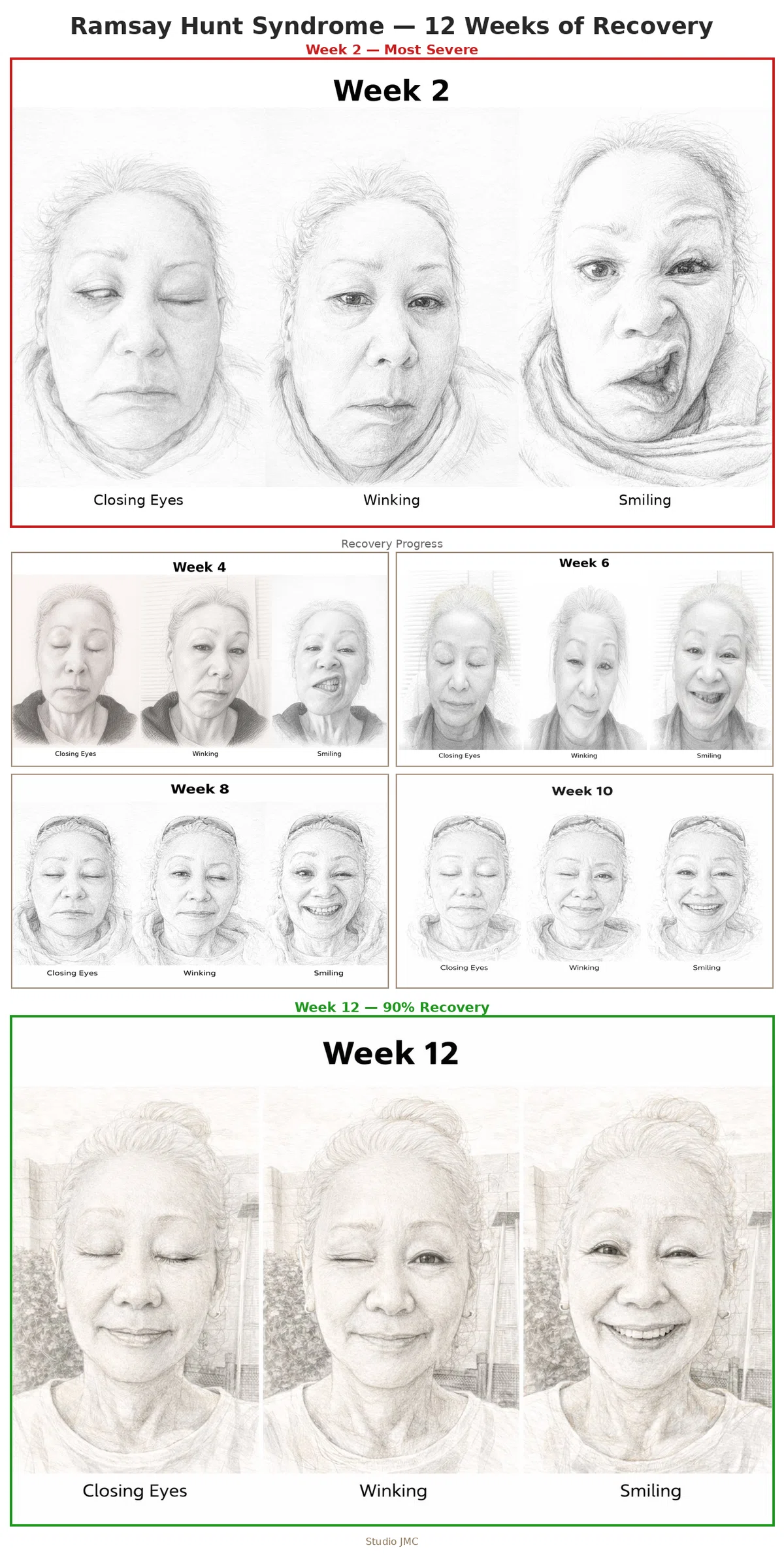
    Junko's face at weeks 2, 4, 6, 8, 10 and 12: closing both eyes, closing the right eye, and smiling
    Weeks 2 through 12. Left to right: closing both eyes, closing only the right eye, smiling.
    • Week 2: severe pain and facial paralysis at its worst
    • Week 4: recovery not progressing as expected, growing anxiety about the future
    • Week 6: subtle nerve activity begins around the eye
    • Week 8: a gap between self-image and actual appearance becomes noticeable
    • Week 10: smiles begin to feel softer and more natural
    • Week 12: a real sense of recovery returning in daily life

    Not everything is back to the way it was. But today, I know this with certainty: I am on my way.

    Three Rita Codes

    There were three quiet rules I held onto throughout my recovery.

    1. Don’t ignore what feels off. Act early. Even a small sense that something is “not quite right” may be a signal from your body. With facial paralysis, how quickly you respond in the beginning can make a real difference. And keep listening all the way through recovery.
    2. Don’t leave everything to others. Seek out the information you need. Try to understand what is happening in your body, what your medications are for, and what treatment options may be available. Ask your doctors questions. Keep a record of your symptoms.
    3. Keep gratitude alive, for others, for yourself, and for this very moment. You don’t have to force yourself to be positive. But notice the small things you can still do today, and gently acknowledge: “I made it this far.”

    Possibility lives in every stage

    What if your initial response was a little late? What if you missed an important sign? It’s okay. In every stage, a new possibility can be born from where you are.

    What you couldn’t do yesterday, you may be able to do, just a little, today. Symptoms that seemed unchanged for weeks may, one day, quietly begin to shift.

    Recovery is not a straight line. There are days it feels like you’ve gone backwards. The speed and the path may differ from person to person, but change does happen.

    Seth’s note

    The meditation and the codes are what Junko credits, not treatments. Her recovery, like mine, started with getting the meds fast and protecting the eye.

    Read Junko’s full series

    This is my story of how I slowly found my way back, and learned to smile again.

    If even a small part of my experience can help someone, that would mean everything to me. Truly.

    Thank you, and ganbatte.

    Keep reading

    This post only scratches the surface. Junko’s ten-part series goes week by week, with her face videos, her full daily routine, a detailed guide to navigating TRICARE and U.S. medical paperwork, and much more on the emotional side. Read Rita Code’s full RHS recovery series.

    Good to know

    This is one person’s account of Ramsay Hunt syndrome, shared in her own words with her permission. It describes what she experienced and what helped her — it is not medical advice, and it is not a substitute for care from your own doctor. If your face has suddenly stopped moving, get seen urgently.
    Gilbert the goose

    The dark stretch never lasts the whole flight. No goose gets left behind — and neither do you.

    Every story here came from someone who decided the next person shouldn’t have to look as hard as they did. If you’ve lived this, we’d like to hear it.


    Share your story

  • Coping with Illness and Pain

    Coping with Illness and Pain

    Coping with Illness and Pain

    A story from the community

    Melanie Albin, Psy.S., LMFT is a marriage and family therapist in Louisville, Kentucky, who has lived with Ramsay Hunt syndrome through three separate episodes. Here she writes from both sides of the chair — as a patient and as a therapist.

    Originally published May 8, 2023 at melaniealbin.com. Republished here in full, with permission and unedited.

    Dealing with illness and chronic pain can be incredibly challenging, often leaving us feeling isolated. As someone who experiences this myself, I want to share what I’ve learned, along with insights from my work as a therapist, in the hope of helping others. My techniques are based on understanding how the brain functions, and I have applied this knowledge to coping with illness and pain. When I teach these techniques, I explain the brain’s role to make it easier to understand how and why they work. The brain is complex, and there is still much to learn about its functioning. We can also look to nature for insights into our physical processes.

    What we know about pain is that it is essential to find ways to stop or interrupt the pain cycle. Managing it often involves medication, and staying ahead of the pain is key to avoiding flare-ups. Finding the right drug and dosage can take some trial and error, and sometimes a mix of medications works best. Having a doctor who really understands your condition is crucial, even if finding one takes time. Learning more about your illness can help you figure out which specialists you need for treatment and pain control. Teaching hospitals can be great resources, often offering neurology clinics run by residents under the guidance of experienced doctors. Pain management specialists focus on care designed to ease discomfort.

    Biofeedback teaches us how to make small adjustments in our bodies. When stress hits, adrenaline speeds up our heart rate and breathing, and when we’re in pain, our muscles tighten. With biofeedback, we can ease pain, relax our muscles, and slow our heart rate and breathing.

    Neuroplasticity is the brain’s ability to form and reorganize connections, especially when learning something new or recovering from injury. It’s how the brain adapts—rewiring itself by creating new pathways and strengthening existing ones. The more we focus on something, such as pain, the stronger those neural connections grow.

    When we experience pain, it can feel overwhelming and make it difficult to concentrate on anything else. Simple actions, like placing an ice cube on our leg, can create a cold sensation that temporarily distracts us from the discomfort. The key is to find something more engaging than the pain itself, like watching an intense movie, which distracts us. Although the pain may not completely vanish, it can fade into the background of our awareness. Redirecting our focus in this way can help break the cycle of reinforcing pain.

    Additionally, engaging in activities that relax our muscles is beneficial since pain often leads to muscle tension.

    Imagine you are in a relaxing place. When you do, your body thinks you are in that place. And it relaxes you as if you are in that place.

    Studies show that picturing a peaceful setting can trigger physical responses similar to actually being there. It can be tough to focus on guided imagery when we’re in pain. Place an ice pack or heating pad on the forehead or abdomen while taking deep yoga breaths. With regular practice, this mental skill becomes easier to use. Pairing guided imagery with ocean waves, whale songs, or other calming nature sounds or music can help transport us to another place. As we imagine ourselves there, we can relax each muscle group from head to toe—a method called progressive relaxation that can ease pain. There are plenty of guided imagery videos, audio recordings, and mindfulness meditations on YouTube to help with this technique.

    Our thoughts can drift from our imagery, but we can gently guide them back. Thinking about problems can quickly trigger adrenaline. Even just thinking, “We have to hurry,” our body sends a surge of adrenaline as if we need to run there—something we haven’t really needed since our cave-dwelling days. But since we’re not actually running, that burst of energy isn’t useful, leaving us feeling irritable and then anxious. Our body’s way of helping is by releasing adrenaline, responding to our thoughts as if they were literally happening in the moment. Adrenaline impairs our thinking because the brain prioritizes physical energy over cognitive function in stressful situations. It’s important to keep our adrenaline off unless truly faced with an emergency. Constantly running on adrenaline puts a strain on our hearts and lungs, increasing the risk of heart attacks. Plus, when adrenaline disrupts or shuts down the digestive system, it can cause issues like constipation or diarrhea. We don’t have to wait until we have a moment by ourselves; use a moment in our car when we are stuck in traffic, or when we are standing in line at the grocery store. Take some relaxing breaths. Breathe in deep from your abdomen, out through your mouth. Breathe in good energy and breathe out stress. Tell your body to relax. The more you practice it, the more you will benefit from it. If we are in the car with our kids, have them do it too! Teachers can do it in their classrooms. Children are great at imagining, so teach them early how to use their creativity to relax.

    Feelings are like waves that flow in and out of our conscious awareness. The feelings associated with illness and pain are the same feelings we experience when we experience a loss. I believe our feelings are hard-wired. I have observed that feelings of loss remain constant, no matter the type of loss or the circumstances surrounding it.

    Facing an illness goes through the same process of loss as losing a job, experiencing a divorce, or coping with the death of a loved one. We experience various emotions such as sadness, anger, and guilt when dealing with any loss or illness. Verbalizing feelings involves a process similar to grieving the loss of a loved one. Recovery from such experiences typically progresses through four stages:

    1. Denial
    2. The feeling stage (which includes sadness, anger, and guilt)
    3. Recalling positive memories from before the illness or pain
    4. Acceptance

    It’s important to understand that experiencing the stages of grief does not happen in a straightforward, linear manner. People often find themselves moving back and forth between denial and the feeling stage: sadness, anger, and guilt, as well as reflecting on memories of their past, particularly what they were able to do before their illness. Typically, this cycle continues for about six months, after which the denial stage usually comes to an end. The denial stage allows us time to incorporate the repercussions of our illness and gives us time to get used to the idea of our long-term prognosis.

    The second stage is the feeling stage, where waves of sadness, anger, and guilt wash over us. These emotions don’t follow any set order—they come and go. They shift unpredictably, moving from one feeling to the next, or from one memory to another.

    The third stage is the memory stage, filled with recollections of healthier days before pain and illness. These memories can be intrusive, bringing flashbacks that stir sadness and anger because illness now limits activities once enjoyed. Pain keeps us from pursuing hobbies, interests, and sometimes even simple daily tasks.

    Ideally, painful feelings and memories can be acknowledged and verbalized so that over time results in a decrease in frequency and intensity. There are three ways to process feelings and memories,

    1. verbalize them to someone we trust
    2. acknowledge and express them through crying, journaling or
    3. express them creatively through art, music, dance, or poetry.

    Feelings can hit us at the worst times, and when we’re swept up in them, it can feel like we’re drowning. Coping skills can help pull us out so we can choose a better time to talk about what’s going on or simply allow ourselves to feel it. Bottling emotions can lead to stomach issues, loss of appetite, and depression. Think of your stomach like a balloon—talking or thinking about feelings lets some of the air out. When we stuff feelings too much, they can show up in our dreams, and unprocessed losses can turn into a depression that lingers just below the surface.

    Joining a group of people who share the same illness or pain, such as a Facebook group, can be incredibly valuable. The wealth of information shared is priceless, as members are often at different stages of their journey and can offer insights to help us move forward. And who better to truly understand our feelings than those who have been through the same struggles? In these groups, we can express our emotions, be understood, and feel supported, making the journey less lonely. Talking to a therapist can also help us work through feelings of anger and sadness.

    It takes anywhere from 2-4 years to process a loss. The more we process our feelings, the less intense and the less frequent, they become over time.

    Memories of things we used to do that we can no longer do because of our illness may trigger sadness and anger. When we process feelings, it triggers our adrenaline. To turn off our adrenaline, always follow processing feelings with any of our coping skills to rebalance ourselves. Use whatever pace works taking control of when and how much to process at any given time. See my coping skills blog below for your convenience.

    Any new loss will retrigger our feelings. Our feelings are all categorized in our brain in the same place, just like a single file on a computer so when you open it up, all of the experiences we have had that caused that same feeling, come tumbling out. If we haven’t processed our feelings from this loss, they will be retriggered when another loss occurs, and they will have the intensity that we left.

    The last stage is acceptance, when we’ve adjusted our lives to better care for ourselves. This can mean improving coping skills, changing up exercise and physical activities, exploring new hobbies and interests, adapting our daily routines, and recognizing our limitations. It’s also about learning to reach out for support, even if it doesn’t come naturally.

    Coping with stress is all about turning off our adrenaline, which is our body’s only way of helping us. This is true when we are in a stressful situation and when we are thinking about a stressful situation. This includes when we are processing the loss of a loved one or loss of health or pain. When our adrenaline is running, we are irritable and then become anxious. Adrenaline speeds up our heart rate and our breathing and it shuts down our digestion and immune system. The stress cycle ends with us feeling depleted or depressed. We are more apt to get sick when our stress cycle is running because our immune system is off. It’s off because our body pulls all our resources to fight or flee.

    Anytime our stress level is higher than our coping techniques, we feel irritable and anxious and then depleted and depressed.

    There are 4 categories of coping skills:

    1. exercise or physical activity
    2. hobbies or interests
    3. friends and support
    4. relaxation

    If you are under normal stress, (stress is the amount of change you are experiencing), you want to use each category 3 x a week for 20 minutes each. Two coping skills every day for average stress.

    If our stress level is higher than normal, and coping with illness and pain is higher than normal stress, we want to increase our coping skills to match our stress level. If we feel irritable, then our adrenaline is still running, and we want to add more coping skills. What is higher than normal stress? Any problem that needs solving, a job change, promotion, divorce, and loss of health or pain. The death of a loved one is the highest stress level that exists.

    Each of the 4 categories of coping skills work differently to turn our adrenaline off. Understanding how they work, helps us decide which category to use.

    When our stress is from an illness or pain, we have to replace many of the coping skills we had previous to the illness.

    1. Exercise and physical activity including cleaning because it uses up our extra energy. (Adrenaline = Energy) Exercise and physical activity will use up energy as long as we are not thinking about what triggered the stressful situation or problem. If we continue to think about it, our body will trigger more adrenaline because it’s the only way our body has to help us. If it’s a problem that needs to be solved, don’t think about it before going to sleep because our body will just produce more energy because our body thinks we need to stay awake to solve it right now. Look for options earlier than bedtime. There are at least 3 options for every problem. See the problem-solving blog for more information. I’ve adapted the information at the bottom of this blog post because encountering a new illness is also a problem to be solved. Walking, yoga, and swimming are examples.
    2. Escaping with hobbies or interests. Hobbies and interests work because when our mind is occupied while we are doing our hobby with friends or by ourselves, we are not thinking about whatever we were stressed about. After 20 minutes, our body turns off our adrenaline.
    3. Friends and support can work in two different ways. First, spending time with friends can be an escape. Or second, talking about it can be helpful in two ways. If stress is a problem that needs to be solved, more heads are better than one when looking for options to solve a problem. And second, feelings can be processed. Talking about it” is letting air out of the balloon”.
    4. Relaxation. We want to choose ways to relax that get our heart rate lower than it is when we are resting. As an example, watching fish in an aquarium works because the movement is slower than our heart rate. Taking a bath with candles and listening to spa music where music is designed to slow our heart rate like Bach. Use progressive relaxation (telling each muscle group to relax starting with your head to your toes) or use visualization (imagine we are someplace relaxing). Inconsequently, when our heart rate is lower than it is when we are resting, our body thinks we are asleep, and it reboots our immune system.

    In summary, use at least 2 coping skills a day, from each category, for 20 minutes each. Add more coping skills when we are having higher than normal stress on a particular day, or a particular time in our life. The goal is to keep our adrenaline off, so we are not running the stress cycle. (Triggering adrenaline and then being exhausted). We want to have at least 3 or more different types of coping skills in each category, to choose from on any given day, to create balance in our life. Three or more ways to use up our adrenaline, yoga, walking, and cleaning. Three or more types of hobbies; playing with dogs, watching movies, reading a book. Three close friends that we can confide in and three or more friends we can do activities with. And three different ways to relax; guided imagery, massage, or acupuncture. We have to consciously add them into life and when we lose interest in one, we replace it with another.

    If we were to only have one coping skill in each category, it is too limiting. For example, if it is one type of exercise, it’s too demanding physically on one part of our body, like running, we injure our knees or only walking it’s too much strain eventually on our feet. If we are limited to one friend, when that friendship ends, it’s devastating. If shopping is our only hobby, then we overspend because we are always going to that activity, when we need an escape.

    My coping skills and my distractions from my pain are snuggling with my 3 dogs, enjoying my goldfish and koi pond, watching my 55-gallon aquarium with goldfish and koi, listening to my zebra finches and my canary, growing indoor and outside flowers and plants, and listening to books from the library on my phone. They are some of my coping skills that bring me joy. They help pull me out of my experience of pain into the present moment.

    Unfortunate as it is, our illness is a problem that needs to be solved. I apply my problem-solving techniques to having an illness below. See my problem-solving blog for more details about problem-solving skills.

    Problem-solving skills in a nutshell: At least 3 options exist for every problem.

    That includes managing our illness. We have to make treatment decisions that lead to the best outcome. It’s important to learn about our condition so we know which physician specialties to seek out. Research can be done online and through consultations with experts. Finding a knowledgeable team of doctors takes time, and the narrow focus of some specialties means we need to be diligent in finding all the care we need to support healing. For the best results, it’s an ongoing process of gaining knowledge and scheduling appointments with various specialists.

    Since even thinking about a problem triggers adrenaline, which then starts the stress cycle, we want to turn our adrenaline off after researching or problem-solving our illness. We can take some deep breaths and imagine we are in a relaxing place. Or spend 20 minutes exercising, cleaning, or engaging in a hobby or interest for 20 minutes. Any of these will turn off the adrenaline and the stress cycle. Once we have at least three treatment options, consider or list the pros and cons of each one. Then, think about or list the short- and long-term consequences of each option. Then we are in the best position to decide on an option. And we can stop thinking about it for now because unless we come across new knowledge that requires action or another option, we do not want to turn on the adrenaline, which then turns on the stress cycle.

    In summary, coping with illness and pain takes numerous skills. First, our illness is a problem to be solved. We have to research our illnesses to gain information and knowledge that will empower us to find the specialists we need to treat us. Our team may consist of three or four different specialists, a pain management doctor, and a physical therapist.

    We have to increase our coping skills during our illness, and if we have chronic pain, continue to have additional coping skills to distract us and bring us momentary joy or pleasure. We can create hobbies that distract us from the pain. We can find support from people who suffer from the same illness.

    It takes two to four years to process the feelings associated with having an illness. Allow ourselves to feel and verbalize or journal, anger and sadness, without getting stuck in our feelings. Follow our expression of feelings with coping skills to pull us out of them. This processing will let air out of the balloon, so our feelings become less intense and less frequent over time, rather than stuffing or swallowing them, which would create long-term depression and digestive issues.

    It helps to consciously keep adrenaline in check by matching our coping skills to our stress levels. Using visualization and relaxation techniques can ease pain and break the stress cycle. The more we practice relaxation and guided imagery, the better our bodies become at relaxing, making it easier and more effective to manage discomfort. Turn off our adrenaline by simply telling ourselves, either out loud or silently, “I’m calm and relaxed,” and our body will respond by relaxing. The more we practice it, the deeper our body will respond and relax.

    Look for medication that can break the pain cycle and take it regularly to stay ahead of the discomfort. It might take a mix of medicines and some trial and error to figure out the right one and the right dose to prevent breakthrough pain. Work with a knowledgeable doctor and keep the communication open to find what works best.

    The more we keep our focus off the pain, the better. Consciously pull your mind away from reinforcing the pathway from the pain to the brain. Interrupt it with medication, coping skills, guided imagery and relaxation, exercise, watching a movie, taking a bath or shower, listening to music or a book, or talking to someone. Find positive affirmations that encourage you.

    Think of things to be grateful for. Thinking about what we are grateful for actually attracts more things to be grateful for.

    Universal laws exist that affect us every day. The Law of Attraction. “We attract to our lives what we focus on.” Every aspect of our lives is governed by Universal Laws. Not only “The Law of Attraction” but “The Law of Cause and Effect”, “The Power of Expectancy”, “The Law of Belief”, “The Law of Love”, “The Law of Guidance”, “The Law of Balance” (Bringing balance to your life.), and “The Law of Multiplicity”. “The Law of Multiplicity is the effect of our actions multiplied. If our intention, thought, or action is kind to ourselves or others, that kindness comes back to us multiplied.

    A lesser-known and often misunderstood concept is the “Law of Manifestation.” Our thoughts, when held onto long enough, shape our reality. If we desire something but stay focused on the wanting, the universe can’t deliver it because we’re fixated on the lack of it. By believing wholeheartedly that we already have it and feeling grateful for it, if it’s in our highest good, the universe will bring it to us. The most straightforward book I’ve found on Universal Laws is Your Life: Why It Is the Way It Is and What You Can Do About It—Understanding the Universal Laws by Bruce McArthur.

    My self-help book was inspired by my patients who wanted to know if I had written down what I teach in therapy. After three patients asked me, I began writing it down, and it turned into this book. I offer a philosophy of healing holistically, physically, emotionally, cognitively, spiritually, and interpersonally. “Total Wellness” and “How to Live a Peaceful and Harmonious Life”.

    Message me if you are interested in purchasing a copy of my book. You can mail me a check, and I will mail you a copy.

    Please see my blog about my journey with Ramsay-Hunt Syndrome.

    Good to know

    This is one person’s account of living with chronic illness and pain, shared in her own words. It describes what has worked for her, drawing on her own experience and her work as a therapist — it is not medical advice, and it is not a substitute for care from your own doctor or a licensed mental health professional. If you’re struggling, please reach out to someone who can help.

    Gilbert the goose

    The dark stretch never lasts the whole flight. No goose gets left behind — and neither do you.

    Every story here came from someone who decided the next person shouldn’t have to look as hard as they did. If you’ve lived this, we’d like to hear it.

    Share your story
  • My Journey with Ramsay Hunt Syndrome

    My Journey with Ramsay Hunt Syndrome

    My Journey with Ramsay Hunt Syndrome

    A story from the community

    Melanie Albin, Psy.S., LMFT is a marriage and family therapist in Louisville, Kentucky, who has lived with Ramsay Hunt syndrome through three separate episodes.

    Originally published May 14, 2023 at melaniealbin.com. Republished here in full, with permission and unedited.

    Pain in the ear, eye, mouth, and face can be a sign of Ramsay Hunt Syndrome, a rare complication of shingles that affects the facial nerves. A constant burning sensation suggests nerve damage from shingles, while a swollen feeling can indicate paralysis. Getting prompt treatment with antiviral medication and steroids can lead to a better outcome. Shingles does not always appear with blisters. Starting antiviral treatment within three days of nerve pain onset can help reduce nerve damage and improve recovery. Research shows that IV steroids may boost outcomes even up to two years later. According to an infectious disease specialist, IV acyclovir and IV steroids work faster and more effectively than oral versions. A two-month course of antivirals and steroids was recommended in 2013 when I had my first RHS episode. Since swelling can cause more damage, steroids help reduce it, while antivirals stop further harm from the shingles virus, which attacks the nerve’s myelin sheath. It’s worth discussing a two-month treatment plan with a doctor and possibly consulting an infectious disease specialist or neurologist. Self-advocacy is key, as many doctors may be unfamiliar with RHS due to its rarity. Even after the first three days of symptoms, IV steroids may still offer benefits.

    They put me on IV steroids and antivirals in the hospital, then kept me on them after inserting a port so visiting nurses could come by and teach me how to administer them myself at home. During my second episode of R.H.S., my facial paralysis cleared up within two days on the IV medication. On the oral medication, I only improved from 84% to 64% over 18 months.

    According to my former, highly experienced neurologist, most recovery happens within the first 18 months, with potential for continued progress up to two years. How much you improve depends on the extent of nerve damage caused by the virus before starting antiviral and steroid treatment, and whether symptoms stem from swelling or actual damage. Starting medication within three days gives about a 50/50 chance of full recovery. Receiving IV medication instead of oral increases those chances because it works faster. If symptoms are due to swelling rather than damage, full recovery is possible. IV steroids can boost recovery odds even if not given immediately.

    Ramsay Hunt Syndrome (RHS) affects the ear and the vestibular nerves. As a result, it can often be diagnosed and treated by either an ear, nose, and throat (ENT) doctor or a neurologist. However, specialists for Ramsay Hunt Syndrome are not very common. Due to its effects on the ears, eyes, and nerves, patients need assistance from three specialists: an ENT doctor, a neurologist, and a neuro-ophthalmologist.

    An ENT may recommend vestibular testing and refer you to a specialist if necessary. Physical therapists can help manage any vestibular damage. Meanwhile, neuro-ophthalmologists focus on addressing eye issues, which is crucial for preventing complications such as dryness from lack of blinking or vision problems associated with RHS.

    Dizziness and balance issues are common symptoms of vestibular damage. You may also experience hearing and vision problems. I underwent vestibular physical therapy to improve my balance because I struggled with nausea and vertigo. An ENT (Ear, Nose, and Throat) specialist may refer you to an ENT specialist who does vestibular testing. This testing involves a series of assessments that evaluate the vestibular system, which controls balance and works with the eyes to maintain clear vision while the head is moving. These tests help determine any damage to the vestibular portion of the inner ear, which can cause dizziness, vertigo, or balance problems. I worked with a physical therapist specializing in vestibular rehabilitation, who taught me how to regain my balance. Since the vestibular function on my left side was compromised, my right side had to compensate for the loss. I also took medication to manage the nausea. Any doctor can prescribe physical therapy, but it’s crucial to seek a vestibular physical therapist for specialized vestibular rehabilitation. This type of therapy is essential for helping the unaffected side adapt and balance for the loss of function on the affected side.

    Scheduling an appointment with a neurologist is recommended, as they can refer you to a specialist for an electromyography (EMG) test to evaluate the extent of paralysis. An EMG is a diagnostic tool that assesses the health of muscles and the nerve cells controlling them. It helps identify problems like nerve dysfunction, muscle issues, or signal transmission between nerves and muscles.

    I purchased a moisture chamber for my eye when it wouldn’t close. This device acts as a protective bubble over the eye until normal blinking returns. If you have an eye condition, it’s advisable to consult a neuro-ophthalmologist who is experienced with Ramsay Hunt Syndrome. My neuro-ophthalmologist recommended using Optase MGD Advanced Dry Eye Drops and Hylo Night Eye Ointment. It took several months for my eye to start blinking again.

    Gabapentin is commonly prescribed to treat nerve pain associated with RHS, TN, and other neurological disorders. Though initially developed for epilepsy, its efficacy in nerve pain comes from its nerve-calming effects. My neurologist started my treatment at 300 mg, but due to excessive sleepiness, the dosage was reduced to 100 mg. Gradually, I increased the dosage to 300 mg. The dosage increased to 600 mg and eventually to 900 mg, taken three times a day. Before switching to Lyrica, my regimen included 1800 mg of Gabapentin three times a day. I introduced Pregabalin, the generic form of Lyrica, which is specifically formulated for nerve pain, and it significantly alleviated my pain.

    I am currently taking 300 mg of pregabalin three times a day, 20 mg of baclofen three times a day, 60 mg of duloxetine, and 10 mg of hydrocodone as needed for severe facial and eye pain. My medication was initially prescribed by a palliative care doctor. I now have a pain doctor whom I highly recommend to anyone suffering from nerve pain. For several years, I have been taking amitriptyline, which helps alleviate nerve pain and improve my sleep. Managing nerve pain is notoriously challenging, and pain management and palliative care specialists often prescribe medications that other physicians may be hesitant to use.

    The nerve pain associated with Ramsay-Hunt syndrome is severe. Despite all my medications, I still experience intense discomfort. The lower eyelid of the affected eye and my face endure excruciating pain, as if someone is pulling my face upward. A constant burning sensation affects my face and eye, and any movement of my eye triggers pain. It often feels like something is pulling at the affected areas. It constantly feels like something is in my eye.

    The medication helps to reduce my pain, but it does not eliminate it. I would be unable to function without it. I experience intense eye pain and vision problems. My nystagmus causes everything to appear as if it is spinning, similar to a merry-go-round. Tracking objects is difficult, and my vision is often blurry. Additionally, the eyelid of the affected eye causes significant discomfort, making it hard to keep the eye open without taking substantial pain medication.

    Palliative care, a branch of hospice, is specialized medical care that focuses on providing relief from pain and other symptoms from a serious illness. Their availability does not depend on whether your condition can be cured, and it does not have to be life-threatening. Their teams aim to provide comfort and improve the quality of life for people with chronic illness and pain. Palliative care is offered in conjunction with other treatments you may be undergoing. It involves a team of healthcare professionals, including doctors, nurses, social workers, chaplains, and specialized practitioners. This team works collaboratively with you, your family, and your other healthcare providers to provide extra support and relief that complements your ongoing care. To find a palliative care doctor, you need a referral from one of your doctors.

    During my first dental visit after experiencing Ramsay Hunt Syndrome (RHS), I discovered that I had six cavities on the paralyzed side of my mouth. To resolve this issue, I bought a Waterpik to help remove food that I couldn’t clear on my own. Additionally, I got an electric toothbrush, and now I use both devices after every meal to prevent tooth loss, which is a common complication of RHS.

    Reoccurring shingles

    The virus that causes shingles is the same one responsible for chickenpox and remains in the body for life. Research indicates that stress can trigger outbreaks of shingles. If shingles occurs near the ear or face, it can lead to Ramsay Hunt syndrome. The shingles virus becomes active when the immune system is weakened. Stress triggers the release of adrenaline, activating the body’s fight-or-flight response, which can suppress the immune system to prioritize immediate action. Additionally, shingles can cause nerve damage in any area of the body where it appears.

    I’ve experienced three episodes of RHS: the first on my left side in July 2013, the second on my right in 2021, and the third on my left side during Christmas 2023. Due to recurrent shingles, I consult an infectious disease specialist and take 1 gram of Valtrex daily, a regimen I’ll continue indefinitely. Initially, my doctor advised against the vaccine until a non-live virus option was available. Shingrix, a non-live virus vaccine, is over 91% effective and seems a viable choice, reducing the risk of contracting shingles to 9% after two doses. Despite the $200 cost with insurance, I proceeded with the vaccination on my doctor’s recommendation. My recurring shingles likely stem from a compromised immune system, evidenced by my IgA immune deficiency and a separate white blood cell disorder that produces abnormal cells. For these conditions, I’m under the care of both an oncologist and an immunologist.

    Learning stress management techniques, particularly how to relax and calm your adrenaline, is beneficial. Imagine you are in a relaxing place. Take deep breaths and learn deep breathing techniques. Both yoga and tai chi are excellent for reducing stress.

    My Ramsay Hunt Syndrome started with ear pain. I went to urgent care, where they thought it was an ear infection and gave me antibiotics. A week later, I returned, and on the tenth day, I woke up with the left side of my face paralyzed. It looked and felt swollen, which I realized later was the paralysis. I had severe nausea, vision issues, and trouble walking. A friend took me back to urgent care, but they couldn’t figure out the cause, so they sent me to an ear, nose, and throat specialist. I was diagnosed with Ramsay Hunt Syndrome, prescribed Valtrex and prednisone, and referred to vestibular physical therapy. Unfortunately, the medication came too late for a good recovery. My facial paralysis worsened from 84% to 64%, though I regained a partial blink. I have intense pain in my left eye and face, constant dizziness like being on a merry-go-round, and ongoing balance problems. I also have nystagmus, vision issues, and 24/7 vertigo. During my second episode, the first symptom I experienced was complete facial paralysis on the right side. After insisting they consult with an infectious disease specialist, I was started on IV acyclovir and steroids at the hospital, and the paralysis improved over the next two days. Despite this, both the hospital doctor and my primary care doctor refused to believe I could have Ramsay Hunt twice, even after I developed visible shingles while hospitalized. They would not continue the medication two days later, after I was discharged. My balance problems became more severe; I needed a walker, and my vision and nystagmus worsened. I had to return to vestibular physical therapy. In this episode, I didn’t receive the medication long enough to see a positive outcome. About nine days later, a neurologist identified the RHS and prescribed the antiviral and steroid, though it was quite late in the process.

    I am a marriage and family therapist who was in private practice until I had to file for disability in 2013 after the first Ramsay-Hunt episode. I kept my office for four years, hoping to go back to work. I have severe pain on the left side of my face and on my eyelid.

    A friend helped me apply for disability by entering all the information into the online application. I collected my doctor’s notes, and she delivered them to the disability office. Another friend, an attorney who assists people with disability claims in another state, advised me not to downplay my symptoms with my doctors since their notes reflect what you say—and that’s what disability doctors will read when reviewing your records. I contacted my state representative and got help from someone in their office who supports people applying for disability. I was approved on my first attempt.

    I woke in 2021 with the right side of my face paralyzed, and I was having trouble balancing. I went to the emergency room, but the hospital doctor did not believe I could get Ramsay-Hunt twice because it’s so rare. They wouldn’t give me the antiviral and the steroid but admitted me to rule out a stroke. After my insistence, they called an infectious disease specialist. I was placed on IV acyclovir and steroids for the two days I was hospitalized. The hospital doctors would not continue the medication, even though I broke out in shingles on my face, neck, and back in the hospital. My facial paralysis on the right side and the balance problems mostly subsided. A few days later, I developed more balance problems and had to use a walker. My vision and nystagmus got worse. I had to go to vestibular physical therapy again. In this episode, I didn’t receive the medication for a long enough duration to achieve a positive outcome. Although I can walk independently, I am experiencing more severe balance problems. My eyes do not blink in unison; my left eye blinks far less frequently than my right. Additionally, both of my eye corneas are damaged from prolonged dryness. The connection between my eyes and brain is impaired. As a result, the images I see are diagonal rather than side by side, preventing them from merging properly. My neuro-ophthalmologist has advised me to wear prism glasses continually to improve my vision. I underwent vision therapy that improved my vision and balance. I wish I had done it sooner. Research to see if you have vision therapy in your area if your vision or balance was affected by Ramsay-Hunt Syndrome.

    Shingles on my neck affected my brain, resulting in cerebellar ataxia. Shingles damages part of the cerebellum, which affects balance and cognition. I went to cognitive therapy.

    My third episode started with 2 shingles in my left ear. Soon after, the left side of my face became more paralyzed, and I have increased difficulty talking out of only the right side of my mouth.

    I feel shocked every time I look in the mirror and see my face. My face appears crooked, and it feels like my brain doesn’t recognize my current appearance. I’m so self-conscious about it that I avoid using FaceTime entirely because I can’t stand seeing my uneven mouth when I talk.

    Inspired by my fellow warriors, I decided to start a blog. I live with facial pain caused by a rare complication of shingles called Ramsay Hunt Syndrome, which has left one side of my face paralyzed and in constant pain. Despite this, I work as a therapist and want to share the knowledge I’ve gained in hopes of helping others. Check out my blog, Coping with Illness and Pain.

    Good to know

    This is one person’s account of living with Ramsay Hunt syndrome, shared in her own words. It describes her experience, her treatment, and her medications — it is not medical advice, and nothing here is a protocol to follow. Ramsay Hunt syndrome is time-sensitive: if you have new facial weakness, get seen urgently and ask about antivirals and steroids. What works for one person may be wrong for another. Talk to your own doctor.

    Gilbert the goose

    The dark stretch never lasts the whole flight. No goose gets left behind — and neither do you.

    Every story here came from someone who decided the next person shouldn’t have to look as hard as they did. If you’ve lived this, we’d like to hear it.

    Share your story