A patient’s field guide — Ramsay Hunt Syndrome
Everything I learned when half my face stopped working.
A plain-language guide to a disease most people have never heard of — written from the inside, not a textbook. The misdiagnosis, the treatment window nobody explained, and the small things that actually helped.
One patient’s experience — not medical advice. When in doubt, get seen.
There was almost nothing out there from someone who’d actually lived it. So I’m writing it.
— Seth · Patient · FounderStart with the basics
What is Ramsay Hunt Syndrome?
The short answer
Ramsay Hunt Syndrome is a rare neurological condition that happens when the chickenpox virus (varicella-zoster) — the very same virus that later causes shingles — reactivates after lying dormant for decades in a nerve bundle near the ear, and attacks the facial nerve. It causes sudden paralysis on one side of the face — usually including the forehead — often alongside a painful rash in or around the ear, hearing loss, ringing, and vertigo. It is frequently misdiagnosed as Bell’s Palsy. Treatment is antiviral medication plus corticosteroids, and it works best when started within about 72 hours of symptoms appearing.
~72 hrs
The treatment window. Antivirals and steroids work best started within about three days.
1 in 3
Cases show up with no rash at all — the main reason it gets missed.
~5 / 100k
People affected per year. Rare enough that many doctors have never seen a case.
Day 1
When eye protection has to start. A paralysed eye can’t blink and dries out fast.
Here’s the part almost nobody knows — I didn’t, until this happened to me: chickenpox and shingles are the same virus. The chickenpox you had as a kid never actually leaves your body. It goes quiet and hides in your nerves for decades. When it wakes back up, that’s shingles. And when it wakes up right next to the facial nerve, it’s Ramsay Hunt Syndrome.
It usually arrives fast: one side of the face goes slack, often overnight. There’s frequently a painful rash or blisters in or around one ear or in the mouth, along with ringing, hearing changes, and vertigo severe enough that walking straight becomes difficult. Unlike a classic stroke, it typically takes the whole half of the face including the forehead — but any sudden facial droop needs urgent evaluation to rule out stroke first.
The critical thing to understand is that how much of your face you get back often depends on how quickly it’s treated. One cited series found full recovery in roughly 75% of people treated within three days, dropping to around 48% between days four and seven, and around 30% after a week. Those numbers aren’t a prophecy — but the shape of them is real. Read the full explainer →
What it is
A shingles flare-up of the chickenpox virus that settles on the facial nerve near the ear.
What you feel
One-sided facial weakness, ear pain or a rash, ringing or hearing loss, and often spinning vertigo.
Why speed matters
Antivirals and steroids work best in the first few days — early treatment is the whole game.
If you were just diagnosed — the first 72 hours
Do these three things first.
If you’re reading this at 2 a.m. with a frozen face and a roaring ear, start here. This is the short list I wish someone had handed me on day one — tap each one as you go.
Get seen urgently — today.
Ramsay Hunt gets brushed off as Bell’s Palsy, an ear infection, or “stress.” Don’t wait it out at home. If there are any stroke-like signs — a drooping arm, slurred speech, weakness below the face — call 911. Otherwise get to an ER or urgent care today.
Watch for the misdiagnosis trapPush for antivirals and steroids early.
There’s a treatment window measured in days, not weeks, and most people are never told it exists. Ask directly about starting an antiviral plus a steroid as soon as possible. If they say Bell’s Palsy but you have ear pain, a rash, or ringing — ask about Ramsay Hunt by name.
The window is smallProtect the eye that won’t close.
When one side of your face goes, that eye stops blinking and can dry out or scratch fast. Drops by day, ointment and a cover at night — starting today. It’s the one injury here that’s both quick and permanent.
This one’s easy to missGet the first-week guide
Want the whole first week in one place?
Everything here, pulled into a single plain-language walkthrough — what to ask for, what to watch, and what actually helps. Keep it on your phone and stop searching at 2 a.m. It’s free.
No spam. Personal experience, not medical advice. Your email stays private, and you can leave any time.
The field notes
What this guide maps.
Four notes, each one a stretch of terrain I had to cross — written plainly, from the inside.
The First Week
The morning it happened, the misdiagnosis that nearly cost me everything, and the two drugs that are the only thing on a clock.
Eye Care
How to protect an eye that won’t close — every drop, tape, and patch by name — so a temporary problem doesn’t become permanent.
The Hard Parts
Vertigo, tinnitus, a metallic mouth, electric zingers, brain fog — and the day you finally look properly in the mirror.
Recovery
The long rebuild. Energy in buckets, the team I built myself, and the free exercises that actually moved the needle.
Common questions
The things everyone asks at 2 a.m.
Short, honest answers to what people actually search for. Every one of these is a question I asked myself.
Is Ramsay Hunt Syndrome a stroke?
No — but a sudden facial droop always needs urgent evaluation to rule one out. A classic stroke usually spares the forehead and comes with other symptoms elsewhere in the body: a weak arm, slurred speech, weakness below the face. Ramsay Hunt typically takes the entire half of the face including the forehead, and often brings ear pain, a rash, ringing, or vertigo with it.
Do not sit at home comparing symptom lists. Get seen today, and let a doctor rule out stroke properly.
What causes Ramsay Hunt Syndrome?
It’s caused by the varicella-zoster virus — the same virus that causes chickenpox. After you recover from chickenpox as a child, the virus doesn’t leave. It goes dormant in nerve tissue and can sit there for decades. When it reactivates, it causes shingles. When it reactivates in the geniculate ganglion — a nerve bundle near the facial nerve — it causes Ramsay Hunt Syndrome.
Risk rises with age and anything that weakens the immune system, but it can strike healthy people of any age. Stress and illness can act as triggers, not sole causes.
How is it different from Bell’s Palsy?
Bell’s Palsy is facial paralysis with no identified cause. Ramsay Hunt is facial paralysis caused by the shingles virus — and it usually brings friends: ear pain, a rash or blisters in or around the ear or mouth, hearing loss, tinnitus, and vertigo. Ramsay Hunt also tends to be more severe and to recover less completely.
The distinction matters enormously, because Ramsay Hunt needs an antiviral as well as a steroid. Here’s the trap: up to one in three Ramsay Hunt cases appear with no rash at all (called zoster sine herpete), which is exactly how it gets logged as Bell’s Palsy. If you’ve been told Bell’s Palsy but you have ear pain, ringing, or balance trouble, it’s reasonable to ask about Ramsay Hunt by name.
Will my face go back to normal?
Often, largely — but honestly, not always completely, and nobody can promise you an outcome. Roughly 70% of people reach complete or near-complete facial function, and how early treatment started is one of the biggest factors. Improvement usually begins around three months, tends to stabilise near six, and healing can continue for up to about two years.
A year in, I’m at about 75%. My smile isn’t all the way back. But I couldn’t drink a glass of water on day one, and I can now. Slow is not the same as stuck.
How long does Ramsay Hunt Syndrome last?
The acute phase — the rash, the worst of the pain, the medication course — is roughly one to two weeks. The recovery is far longer. Most people see meaningful improvement by three months and much of their progress by six, with slow gains continuing for up to two years.
For me: the vertigo lasted about three months. My eye didn’t close properly on its own until month ten. The tinnitus never left.
Is it contagious?
You can’t give someone Ramsay Hunt Syndrome. But the fluid in the blisters carries the chickenpox virus, so until those lesions crust over you could pass on chickenpox to someone who has never had it or been vaccinated. Take particular care around newborns, pregnant people, and anyone immunocompromised.
What’s the treatment?
An antiviral (usually valacyclovir or acyclovir) plus a corticosteroid (usually prednisone), started as early as possible — ideally within about 72 hours. Plus eye protection from day one, and sometimes medication for vertigo or pain.
It’s typically a short course, around 7 to 10 days, and then it’s finished. That surprises people badly — it certainly surprised me. These drugs are the start, not the fix. The full treatment story is here.
What if I’m already past the 72-hour window?
You have not missed your chance to get better. Sooner is meaningfully better, but this is not all-or-nothing. Later treatment still helps, and a facial-nerve specialist can keep improving outcomes months down the line.
Almost everything else on this site — the eye care, the exercises, the rebuild, the patience — is available to you regardless of what day you’re on. The window closing does not close the door.
Why does my eye need protecting so urgently?
The facial nerve controls the muscle that closes your eyelid. When it goes down, that eye won’t blink and won’t fully close — so the surface dries out. A dry cornea can be scratched, and corneal scarring doesn’t always come back.
This is the one thing on this website that gets worse while you’re not looking at it. Drops through the day, ointment and a cover at night, and get an eye doctor to actually look at it. The full playbook is here.
Can the shingles vaccine prevent it?
The shingles vaccine lowers your overall risk of zoster reactivation, so it may reduce the chance of Ramsay Hunt — but it is not a guarantee, and Ramsay Hunt can still occur in vaccinated people. Whether it’s right for you depends on your age and health, and that’s a conversation for your doctor, not a website.

Who’s writing this
I wrote the guide I needed.
I’m not a doctor. I’m someone who woke up on June 27, 2025 with half my face frozen, a roar in one ear, and a room that wouldn’t hold still — and found almost nothing written by anyone who’d actually been through it.
So I started writing it down. The appointments where nobody could name it. The treatment window nobody explained. The small, unglamorous things that genuinely helped. This is that — plain language, no jargon, written from the inside.
It’s not a replacement for your doctor. It’s the thing I wanted next to me at 2 a.m. when I was scared and couldn’t find a single honest account of what was happening to my body.
Read my full storyMeet your field guide
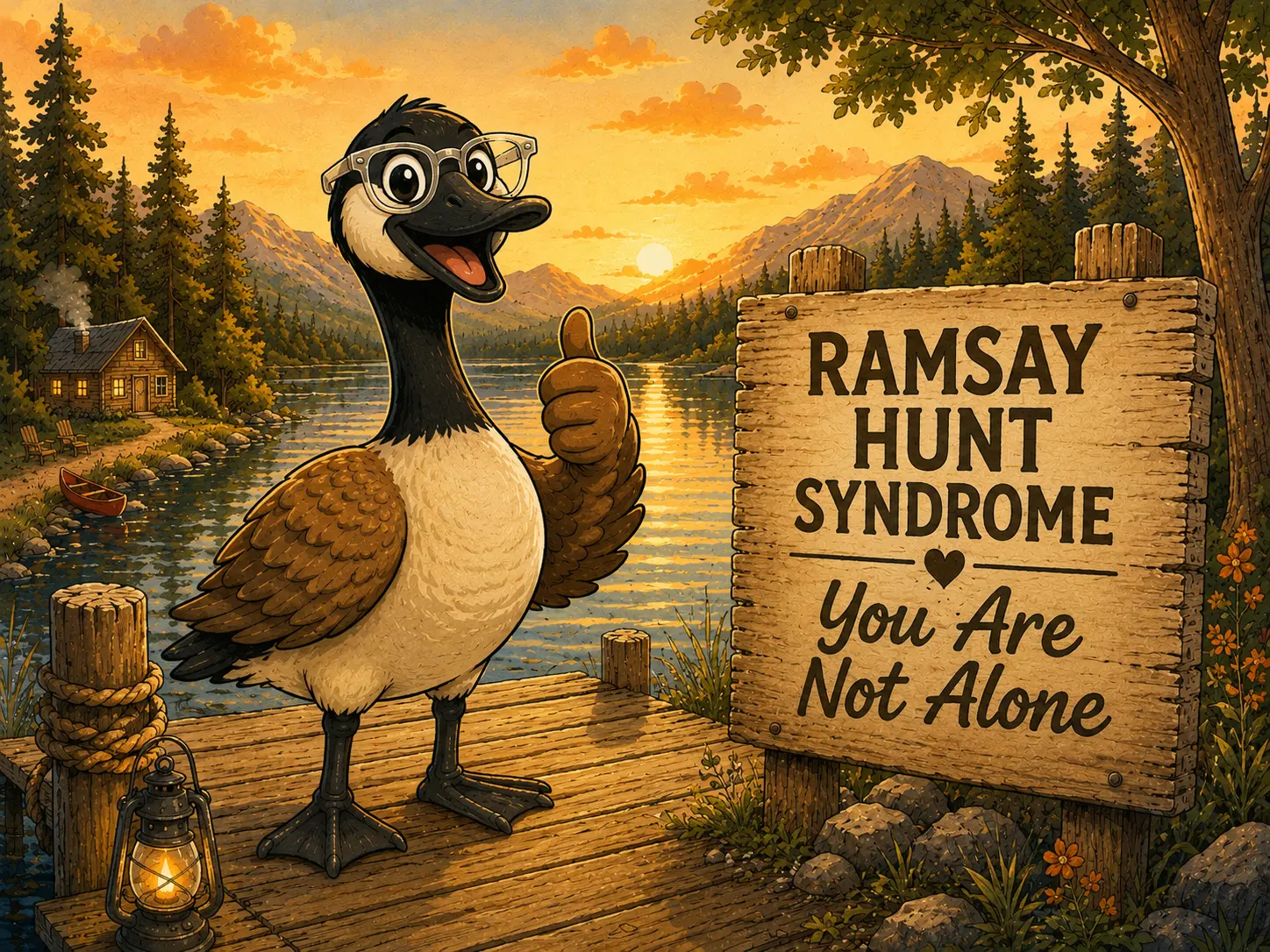
“The dark stretch never lasts the whole flight. No goose gets left behind — and neither do you.”
 Your Friendly Goose & Guide
Where I send people
The clinical side, from sources I trust.
This guide is the human side — what it actually feels like and what helped. For the medical details, diagnosis, and treatment specifics, the clinical references below are the places worth reading, and the facts and figures on this page are drawn from them. The foundations and support groups are where I send people who want community and help beyond the medicine.
Clinical references
Foundations & support
You’re not alone
You’re not the first to walk this ridge.
And you don’t have to do it in the dark. Start with the first three steps — the rest of the guide will be here when you’re ready.
Start here