Newly diagnosed · Start here
If half your face just stopped working, start here.
I woke up on June 27, 2025 with the left side of my face frozen and no idea what was happening. This is the page I wish someone had handed me that morning — the moves that matter most in the first few days, in the order they matter, from someone who has been through it.
One patient’s experience — not medical advice. When in doubt, get seen.
Before anything else
Breathe. Then move fast.
Waking up to a face that won’t move is one of the most frightening things that can happen to a person. I know. The good news buried in a terrible morning: the next few steps are simple, and the sooner you take them, the better this goes.
The first 72 hours
Three moves that actually matter.
The first two are on a clock — the sooner they happen, the better your odds. The third starts today and protects your eye while it can’t protect itself.
That fear is exactly why step one exists — you get seen right now and let a doctor rule it out. Here’s the rough difference, and then please stop diagnosing yourself: a classic stroke usually spares the forehead and comes with other body symptoms — a weak arm, slurred speech, weakness below the face. Ramsay Hunt tends to take the whole half of your face, forehead included. But a drooping face always earns an urgent look to rule out stroke. So don’t sit at home comparing symptoms. Go.
Get seen — today
Get in front of a doctor today, not tomorrow.
If you have any stroke-like signs — a drooping arm, trouble speaking, weakness anywhere below your face — call 911. Otherwise, get to an ER or urgent care today. Not next week. Today. The single biggest mistake with this condition is waiting it out at home to see if it passes.
I went in by ambulance because none of us knew what was happening, and it turned out that being brought in that way put me straight in front of a doctor instead of hours in a waiting room. I’m not telling you to call an ambulance for a face droop — I’m telling you not to wait.
When I called for help, the dispatcher rattled off stroke, heart attack, aneurysm — none of which I had — and I nearly blacked out from the panic. If someone starts naming worst-cases at you, they’re covering every base, not telling you what you have. Breathe. Get in the car. Let the doctor sort it out.
Plain words: one side of my face stopped moving, and it came on fast. Then say all the rest of it — ear pain, a rash or blisters in or around your ear, ringing, dizziness, hearing changes. Those are the clues that point at Ramsay Hunt instead of Bell’s Palsy, and they change what the doctor does next.
They’ll likely run an MRI to rule out anything worse. Mine came back clear, and that alone was a relief. Then comes the call between Bell’s Palsy and Ramsay Hunt — which brings us to step two.
Push for the meds — early
Get the antivirals and steroids started as fast as possible.
This is the one part of the first few days that genuinely changes how you heal — and it’s the part you may have to ask for by name. The standard combination is an antiviral (acyclovir or valacyclovir) plus a corticosteroid (usually prednisone). Together they go after the virus and calm the swelling around the facial nerve.
Sooner is dramatically better. One cited series put full recovery around 75% when treatment started within three days, around 48% at days four to seven, and around 30% after a week. Those aren’t promises — recovery is messier than any percentage, and starting late still helps. But if you take one thing from this whole page: the window is real, so don’t sit on it.
Here’s the trap that catches people, me included. I was sent home told it was “probably Bell’s Palsy, maybe Ramsay Hunt” — leaning Bell’s. They still gave me the antivirals and steroids, and thank goodness they did. If a provider lands on Bell’s Palsy but you’ve got ear pain, a rash, or hearing and balance symptoms, it’s worth asking directly about Ramsay Hunt and about antivirals — because up to one in three Ramsay Hunt cases show up with no rash at all, which is exactly how it slips past doctors.
Nobody told me my prescription was only a short course. I found out the next morning and panicked, sure I’d been left with nothing. So here it is up front: it’s usually a short course — around 7 to 10 days — and then the drugs are done. That’s normal. These pills are the start, not the whole fix. (For what it’s worth, mine ran under $200 even paying out of pocket.)
Protect the eye — starting today
Guard the eye that won’t close, from day one.
When the nerve goes down, the eyelid on that side won’t blink or fully close. That means the eye dries out and can get scratched fast — and getting ahead of that is a lot easier than fixing it later. Treat it as urgent from day one, right alongside the meds.
When I first tried to close that eye, the eyeball rolled up and back and all I could see was white. It looks alarming. It’s actually your eye protecting itself — it’s supposed to roll back to shield the surface. Normal. Not a new emergency.
What to do today, in plain terms:
• Drops through the day to keep it wet. I went through three kinds before one worked for me (Leader artificial tears).
• At night, tape or cover it and use an ointment so it doesn’t dry out while you sleep — even for naps.
• Get an eye doctor’s eyes on it. A dried-out or scratched cornea is the one thing here you really don’t want to gamble with.
I go deep on the exact drops, tapes, patches, and the day-versus-night setup in the Eye Care field note — that’s the full playbook, by name.
Read the Eye Care playbookAfter the first 72 hours
The pills are the start — not the finish.
Here’s the part the hospital didn’t tell me. Once I had the antivirals and steroids, they were mostly out of moves — no cure, no real plan for what came next. That is not me telling you doctors are useless. Getting seen and getting those drugs early is the single most important thing you will do, full stop. But after that window closed, most of my recovery came from a team I had to go build myself: physiotherapy, the right at-home tools, rest, and a great deal of patience.
One free thing changed everything for me. In the early months I couldn’t talk much, so I wrote everything down and used AI — ChatGPT, Gemini, and Claude — to learn the terminology, figure out what to ask my practitioners, and walk in prepared. It made me a sharper patient and got me better answers. It is not a substitute for a doctor or the meds. It just made me far better at using them.
So you know what’s coming
The first two weeks are the worst. That’s normal.
If the drugs don’t “fix” it in a few days, you are not doing it wrong. For me the first couple of weeks were the hardest of the whole thing — the meds themselves, plus vertigo, bone-deep exhaustion, and a face that wasn’t listening. It gets better. Slowly, unevenly, but it does.
Early on I learned to think of my energy as a bucket that empties fast — one phone call or one short walk could spend the whole day’s worth. Spending it on purpose became a survival skill. There’s a lot more on that, the symptoms nobody warns you about, and the month-by-month rebuild in the notes below.
Keep this close
Get the first-week guide.
A short, plain walkthrough of everything above — what to do, what to ask, and what to expect — pulled together so you can keep it on your phone and stop searching at 2 a.m. It’s free.
No spam. Personal experience, not medical advice. Your email stays private, and you can leave any time.
Meet your field guide
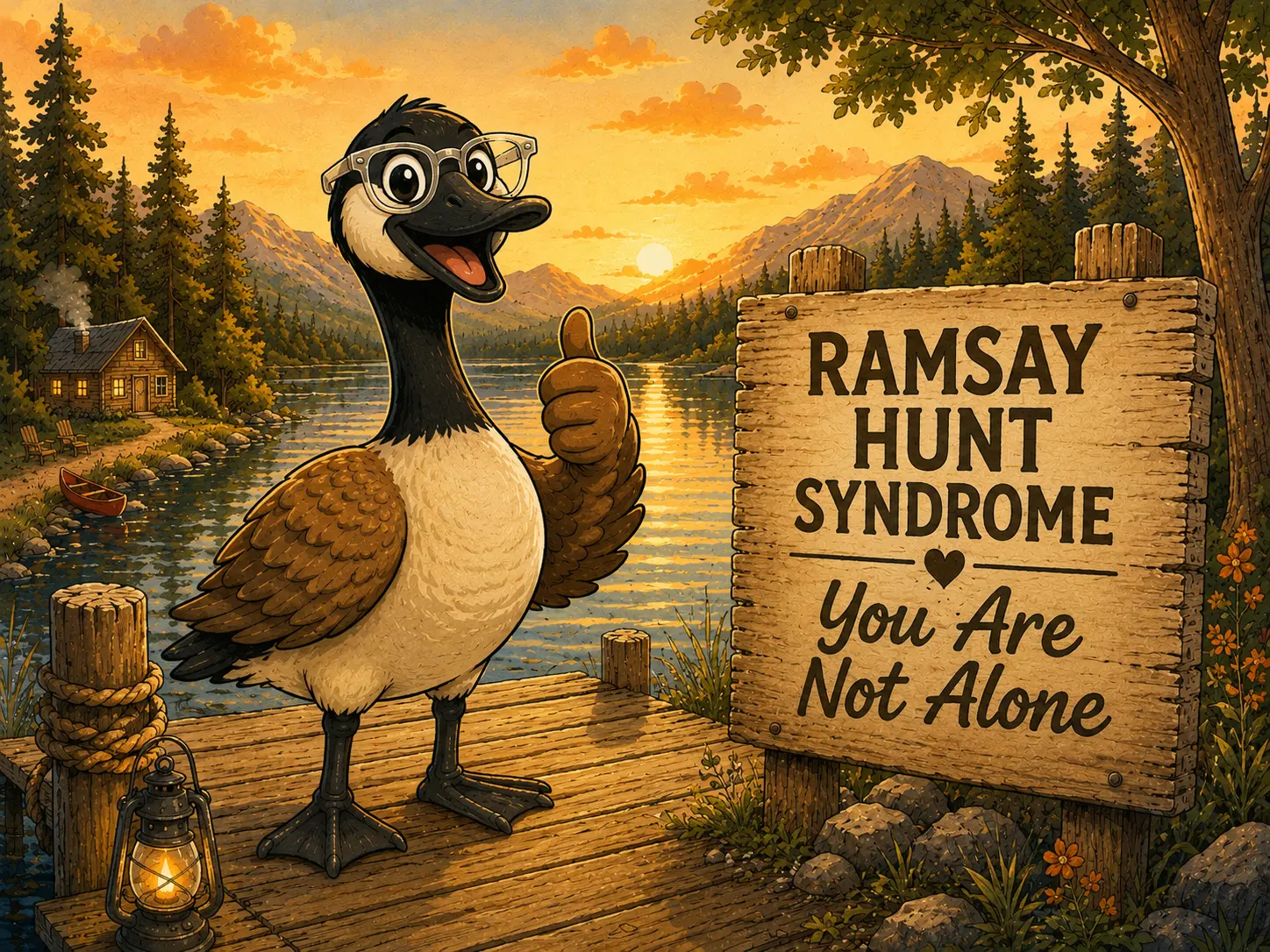
“The dark stretch never lasts the whole flight. No goose gets left behind — and neither do you.”
 Your Friendly Goose & Guide
You’re not alone
Everything is going to be okay.
If you’re reading this in the middle of the night with half your face frozen — not easy, but okay. Use the hospital to get the medicine, then go build your people. Be patient with yourself, and be kind to the face in the mirror, because you’re going to need to love that person through this. You’re not the first to fly this stretch, and you won’t fly it alone.
Read the field notes