
Will I Ever Smile Again? Junko’s Story of Ramsay Hunt Syndrome
Junko, who writes as Rita Code (Studio JMC), is a Japanese-born writer living in Las Vegas. Ramsay Hunt syndrome hit her on January 15, 2026, for the second time in her life, and she documented her recovery week by week in a ten-part series.
Adapted from her English series at note.com/studio_jmc, with permission. Her words have been trimmed and rearranged, with small grammar and spelling fixes. Seth’s notes are marked separately so you always know who’s talking.
Like everything on this site, this is one person’s experience, not medical advice. If your face just stopped moving, stop reading and get seen today.
It started with my right ear
One day, out of nowhere, the right side of my face stopped moving.
Just like that.
It was Ramsay Hunt Syndrome.
From that moment on, every time I cautiously looked in the mirror, one question wouldn’t leave me: “Will this ever go back to normal?”
Day 1: Thursday, January 15, 2026
It started with my right ear.
Maybe it’s a middle ear infection. Still, this prickling sensation feels off. Not quite like an ear infection.
The prickling spread as the night wore on, creeping into my right shoulder, settling around my shoulder blade, and eventually building into a throbbing headache.
I’d been running at full speed for weeks, organizing and hosting a big event, so I told myself I was simply running on empty. Sleep it off. You’ll be fine in the morning.
That morning had started like any other. Up at 4 AM, Ashtanga yoga at 6, followed by a high-intensity Yoga Sculpt class. I was, by all measures, buzzing with energy.
Day 2: Friday, January 16, 2026
I smiled. A perfectly normal, symmetrical smile.
I didn’t know that it would be more than three months before I would see that smile again.
The discomfort was still there: the prickling in my ear, the tension in my shoulder and head. But I had trained myself to ignore pain. When you push your body every day, pain becomes background noise.
Later that day, while having lunch with my husband, I felt it. A sharp, sudden tingling at the tip of my tongue.
This feeling. I know this feeling.
A memory from 13 years ago
Back then, I had been diagnosed with an ear infection. I took antibiotics for 10 days. But the pain didn’t go away.
Then one morning, my son noticed something I didn’t. Half of my face wasn’t moving.
I immediately went back to my doctor and was referred to a larger hospital for an MRI. That’s when I first heard the name: Ramsay Hunt Syndrome.
Junko’s first case, back in 2013, was mild, and she recovered well even though it was misdiagnosed at first. Please don’t read that as a reason to wait. This second time was far more severe. The antivirals and steroids work best when started early, ideally within about 72 hours, and that clock is the one thing you can’t get back.
Then everything changed
My eye wouldn’t close. My mouth wouldn’t open properly, making eating difficult. I couldn’t speak clearly. Even small sounds felt painfully loud. The pain in my right ear intensified. The room spun when I lay down. A suffocating, trapped sensation. Anxiety, loneliness, a silent panic.
The entire right side of my face stopped moving.
It was my face, but it didn’t feel like mine anymore.
The midnight conversation, and the ER
That night, I reached out to Memory-chan, my nickname for ChatGPT, and described what I was experiencing. The glow of my iMac screen was the only light in the room.
She began listing possible causes, one by one. Then I saw it: early-stage shingles or Ramsay Hunt Syndrome. A tingling tongue plus one-sided ear pain is a warning sign.
The moment I read those words, the dam broke. Thirteen years of buried memory came flooding back all at once.
“Trying to push through it won’t help this time.”
She knew me. She knew that pushing through is my default setting. And that single line hit harder than anything else.
My right eye wouldn’t close properly. I told her. Her reply was immediate: antiviral medication is most effective when started early, ideally within 72 hours. “Do not wait until tomorrow. Go to the ER now.”
The story I’d been telling myself, I’ll be fine, quietly collapsed.
At 11 PM, I woke my husband.
This is exactly how I think about AI in all this. It didn’t replace a doctor. It pushed her to go see one, fast, while the window was still open.
The freezing waiting room
The waiting room was bitterly cold. I sat next to my husband, shivering, clutching myself, waiting for my name to be called.
My husband’s shoulder was just inches away. But he was still in the healthy world. And I was about to step into a different one.
That invisible wall between us felt colder than the room.
“There’s nothing wrong with your brain”
When I described the facial paralysis, the nurse’s hand, the one writing on the chart, stopped. Just for a moment. Around me, an invisible teamwork was quietly clicking into gear.
The doctor examined the movement in my face. At this point, it could not yet be distinguished from Bell’s palsy. “The medication I’ll prescribe is effective for both,” the doctor said. Antivirals and steroids for one week, plus an antibiotic eye ointment to protect the cornea of my exposed eye.
But first, a CT scan, to rule out stroke.
After the scan, the doctor looked at the monitor and said, clearly and calmly: “There’s nothing wrong with your brain.”
If you’re experiencing the onset of facial paralysis right now, here’s the one thing I’d urge you to do before anything else: confirm that it’s not a brain-related condition.
Of course, this isn’t something you can confirm on your own. What it really means is this: get to the ER as quickly as possible, so a doctor can examine you. That, above all, is what matters most.
The first week
Unlike my first episode 13 years ago, this time I started treatment within what’s called the Golden Window: the critical 72 hours after symptom onset. At the time, I didn’t fully grasp why those 72 hours mattered so much. I just listened, and acted.
The standard protocol after that? Rest. Slow down. Let your body heal.
This time, though, the symptoms hit harder. Searing pain in my right ear. Vertigo. Nausea. Distorted hearing. Lost taste. Difficulty eating and drinking. Unable to rinse after brushing my teeth. My eye wouldn’t close fully, half-open all the time, with constant dryness and pain. Wave after wave, in no particular order, relentless.
What I actually did that first week
- Scheduled an appointment with my primary care physician
- Bought eye-protecting tape and an eye patch
- Joined a Facebook support group and posted right away; found my people
- Searched for others who had shared their experience online: YouTubers, bloggers, survivors
- Found Facial Palsy UK, an incredible resource, and learned about eye taping and so much more
And through all of it, I gave myself more time than usual for everything. Meditation went from 10 minutes to 20 or more. Sleep went from my usual 4 to 5 hours to 7 or more, napping whenever my body asked for it. Meals stretched from 30 minutes to an hour or more, since the paralyzed side made chewing difficult.
Do what you want to do. Don’t force what you don’t.
When you can’t smile, what face do you make?
I’ve always been someone who smiles. It’s just what my face does. And suddenly, I didn’t know what expression to wear. How to hold my face. What to do with it.
My friends were wonderful. Every day, messages of encouragement. And I knew that if I saw them in person, they would say, with complete sincerity, “You look totally fine. Don’t worry at all.”
And that kindness would break me open. Not because it would be unkind, but because it would be so heavy with love that I wouldn’t know how to hold it.
It seemed the paralysis wasn’t only on half my face. My spirit, too, had lost its balance.
Still, I needed to move my body somehow. So I stood on my yoga mat. Didn’t do anything. Just stood there. And then something shifted.
This isn’t the time to worry about what face to make. Right now, it’s time to protect myself, not just my body, but my heart.
So: when you can’t smile, you don’t have to. Just let your face be whatever it is.
What I wish I’d known from the first day
- Your nerves aren’t broken. Think of it like a lamp that isn’t plugged in. The switch still works. The bulb is fine. The connection just needs to be restored.
- Nerve recovery happens slowly, about 1 millimeter per day. That’s why it takes weeks or months.
- Facial rehab is not muscle training. It’s about gently reteaching the nerve the right movements. Pushing harder actually makes things worse.
- Right now, not trying is the bravest thing you can do. Resting is the treatment.
“But you look so good” is the phrase I hate most, and Junko nails why. The people saying it mean well. It still lands wrong.
Protecting the eye, and everyday life
During my RHS recovery, nothing demanded more of my attention than my eye.
An eyelid that won’t fully close means a cornea that is constantly exposed to open air. And if the cornea gets damaged, you’re no longer just recovering. You’re facing a new and serious problem. That’s why eye protection is priority number one.
At my ophthalmology visit, I was told to use the prescribed drops every two to three hours. In other words: nearly continuous drops, all through my waking hours. My ophthalmologist prescribed three things: preservative-free lubricating drops for the daytime, a moisturizing ointment for the night, and an antibiotic ointment to protect against infection. I also received a moisture chamber, a clear protective cover that keeps the humidity in. It helped me enormously.
Taping the eye at night
In the earliest days after onset, my eye wouldn’t close at all, so I kept it taped through the daytime too. I tried paper tape and silicone tape; they’re gentle on the skin, but they kept peeling off during the night. A surgical tape that held firmly served me best.
- Gently close the eyelid with your finger first, then secure it from above.
- When taping during the day, don’t forget your eye drops and your nighttime ointment.
- When you remove the tape, never pull it off roughly. Peel it off slowly, from the bottom upward, or you may pull out your eyelashes.
- As the eye starts to open a little over time, be careful that the eye and the tape don’t touch.
Tips for everyday life during recovery
- Avoid driving until your eye can close completely. I drove myself to acupuncture with an eye patch on, and my field of vision was so narrow it was frightening. I took the patch off, and then my eye was dry and hurt. Whichever you choose, you can’t drive safely.
- Be twice as careful in the kitchen. Holding a knife while seeing mainly through one eye is more dangerous than you might think.
- Use earbuds only in the healthy ear. Everyday sounds came through my right ear almost like a roar. I kept the volume much lower than usual.
- Keep your mouth even cleaner than usual. Food gets trapped on the paralyzed side. A few months later, a large cavity was discovered on my paralyzed side. Sigh.
- Use the handrail on stairs. RHS can have a major effect on your balance. Even I had to remind myself not to overestimate the balance I’d built through yoga.
Eye care is the most urgent practical thing on this whole site. Get an eye doctor to look at it early. For what I personally used, see the Toolkit.
Inside the tunnel
Around week three, even as I made resting my body and mind the first priority, I kept myself busy: medical and insurance procedures, appointments with specialists, protecting my eye, managing the pain. As long as I kept moving, my head and my heart were still, somehow, staying in gear.
But the moment I drifted into sleep, a feeling sometimes took hold of me: as if my body were being folded up into a veil of blackness, then dragged straight down, all at once.
Thirteen years ago, soon after my first RHS, my life began to crumble. So this time, a question kept rising: “Isn’t this, once again, the herald of some great storm in my life?”
So I tried a little experiment. I wrote those fears down, as honestly and clearly as I could. And I was quietly astonished. Every one of them, once it became words, wore the face of the future.
What I had been fearing was not a premonition. It was nothing more than the story of a memory, thirteen years old.
Settle into the darkness
How much longer until further recovery? Would any aftereffects remain? When would my eye close? Would my smile ever return? The exit was still nowhere in sight.
To that version of me, in her third week, here is what I would like to say:
In a pitch-dark tunnel, straining desperately to see around you will only wear you out. Until you’re through it, just settle deep into the darkness, and be still.
What cannot be seen stays unseen. What does not move stays unmoving. When you want to cry, let yourself cry. If a smile is impossible, that’s all right. You don’t have to put on a bright face.
The person beside me
Inside that dark tunnel, I was never alone. My husband stayed by my side, always.
When illness comes, so many things get stripped away. Vanity. Bravado. The self whose job it was to laugh brightly and light up the room. What remains? Someone who, without being asked for anything, is simply there.
And there is one more thing I learned: say clearly what you want to say. To my ears, made hypersensitive by the symptoms, even his voice, just slightly raised, brought considerable pain. Rather than crying out, “Why don’t you understand!?” I would explain, carefully, the nature of this illness and the specific things I needed his help with.
Precisely because we are at our weakest, communication with the ones we love may need to be polished one degree finer.
I no longer need to carry anyone’s anxiety
When I fell ill, the first thing I felt was not only my own pain. Though I was the one with the illness, I had somehow been trying to become the one in charge of sorting out the feelings of everyone around me.
Another person’s anxiety belongs to that person. Another person’s reaction belongs to that person.
My smile had always been my way of putting others at ease. Now I could no longer do it. The corner of my mouth would not lift. Just talking with someone tired my face. So the smile and energy I usually gave away, I had to hold in reserve for myself alone.
The first step toward making the people around me happy began with my making myself happy.
Twelve weeks later
Long before RHS, I had twice attended a ten-day Vipassana meditation retreat. What you train there is one thing only: to simply observe the sensations that arise in your own body.
When the right half of my face stopped moving, I had a rather unusual thought: “Let me place that paralyzed face itself as an object of observation.”
Quietly, I turned my awareness inward. And in the right side of my face that should not move, deep within, a faint vibration, something like the faint ache of a nerve, came trembling through. A sensation so small you could dismiss it as imagination.
In that instant, the dreaded face of paralysis transformed from an enemy into a companion walking alongside me.
Nerves are roots. Breath is water. Pull at them in haste, and the roots will not grow. You simply give water, let the sun in, and wait.
A visual record of change
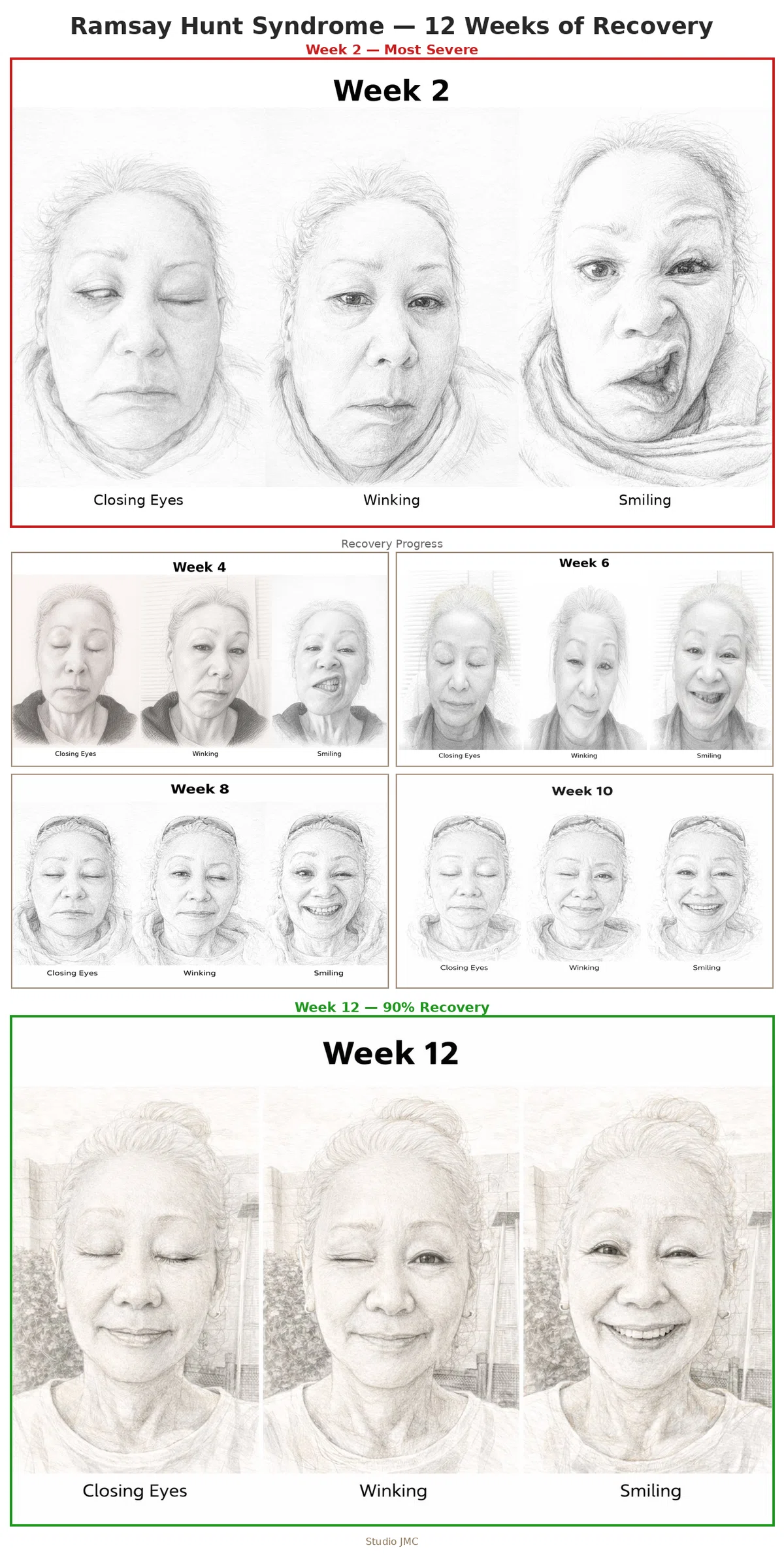
- Week 2: severe pain and facial paralysis at its worst
- Week 4: recovery not progressing as expected, growing anxiety about the future
- Week 6: subtle nerve activity begins around the eye
- Week 8: a gap between self-image and actual appearance becomes noticeable
- Week 10: smiles begin to feel softer and more natural
- Week 12: a real sense of recovery returning in daily life
Not everything is back to the way it was. But today, I know this with certainty: I am on my way.
Three Rita Codes
There were three quiet rules I held onto throughout my recovery.
- Don’t ignore what feels off. Act early. Even a small sense that something is “not quite right” may be a signal from your body. With facial paralysis, how quickly you respond in the beginning can make a real difference. And keep listening all the way through recovery.
- Don’t leave everything to others. Seek out the information you need. Try to understand what is happening in your body, what your medications are for, and what treatment options may be available. Ask your doctors questions. Keep a record of your symptoms.
- Keep gratitude alive, for others, for yourself, and for this very moment. You don’t have to force yourself to be positive. But notice the small things you can still do today, and gently acknowledge: “I made it this far.”
Possibility lives in every stage
What if your initial response was a little late? What if you missed an important sign? It’s okay. In every stage, a new possibility can be born from where you are.
What you couldn’t do yesterday, you may be able to do, just a little, today. Symptoms that seemed unchanged for weeks may, one day, quietly begin to shift.
Recovery is not a straight line. There are days it feels like you’ve gone backwards. The speed and the path may differ from person to person, but change does happen.
The meditation and the codes are what Junko credits, not treatments. Her recovery, like mine, started with getting the meds fast and protecting the eye.
Read Junko’s full series
This is my story of how I slowly found my way back, and learned to smile again.
If even a small part of my experience can help someone, that would mean everything to me. Truly.
Thank you, and ganbatte.
This post only scratches the surface. Junko’s ten-part series goes week by week, with her face videos, her full daily routine, a detailed guide to navigating TRICARE and U.S. medical paperwork, and much more on the emotional side. Read Rita Code’s full RHS recovery series.
This is one person’s account of Ramsay Hunt syndrome, shared in her own words with her permission. It describes what she experienced and what helped her — it is not medical advice, and it is not a substitute for care from your own doctor. If your face has suddenly stopped moving, get seen urgently.
The dark stretch never lasts the whole flight. No goose gets left behind — and neither do you.
Every story here came from someone who decided the next person shouldn’t have to look as hard as they did. If you’ve lived this, we’d like to hear it.